
Airlines and shipping carriers are facing mounting disruption from the widening conflict involving the US, Israel and Iran, as uncertainty over the war’s duration rocks global supply chains.
On Monday (March 9), Trump claimed the war would be over “very soon” before warning of more aggressive actions against Tehran and suggesting fighting would continue for at least another week – leaving operators increasingly reluctant to move vessels or aircraft through the region.
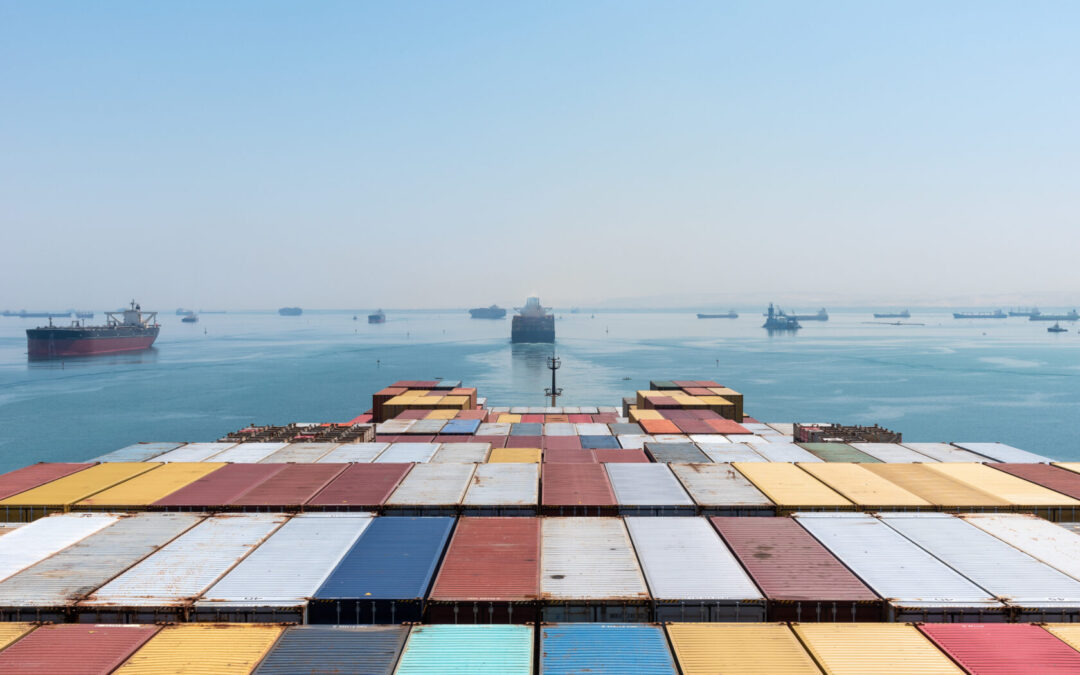
At the centre of the disruption remains the Strait of Hormuz, the narrow waterway linking the Persian Gulf to global shipping lanes. More than 130 vessels carrying around half a million TEU are believed to be trapped inside the Gulf, with clusters of container ships and tankers anchored outside the strait pending risk assessments, ship-tracking data shows.
The crisis has spread beyond Hormuz. Traffic through both Bab al-Mandab and the Suez Canal has largely halted, creating a dual chokepoint crisis across the region’s key waterways. Meanwhile, Bahrain’s Manama port has been rendered entirely non-operational.
Electronic interference may also be affecting ship navigation systems near the strait, analysts say, complicating transits and further deterring operators from attempting the crossing.
The world’s largest container lines have responded accordingly, with MSC, Maersk, Hapag-Lloyd and CMA CGM having suspended services, stopped bookings or diverted cargo away from the region.
Insurance markets have also reacted swiftly. War-risk cover has been withdrawn across several Gulf states, with further cancellations expected in the coming days. The loss of coverage is leaving many shippers exposed to uninsured risk and forcing operators to reconsider voyages through the region.
Meanwhile, global bunker prices have surged, with IFO380 heavy fuel oil reaching $841 per tonne.
The disruption extends to air freight. Gulf carriers including Qatar Airways and Etihad have partially resumed limited commercial flights, but most scheduled services remain suspended.
Air freight costs between Asia and the West surged by 50 percent in a single week, leaving many time-sensitive goods stranded on the tarmac.
Uniserve’s response
Uniserve and teams across GB Global are in continuous contact with airlines, carriers, overseas offices and security advisers. We are actively assessing alternative routings and monitoring all carrier notices, airspace restrictions and maritime security alerts.
For support or further information, please contact our Client Relationship Management Team at: crmteam@ugroup.co.uk