
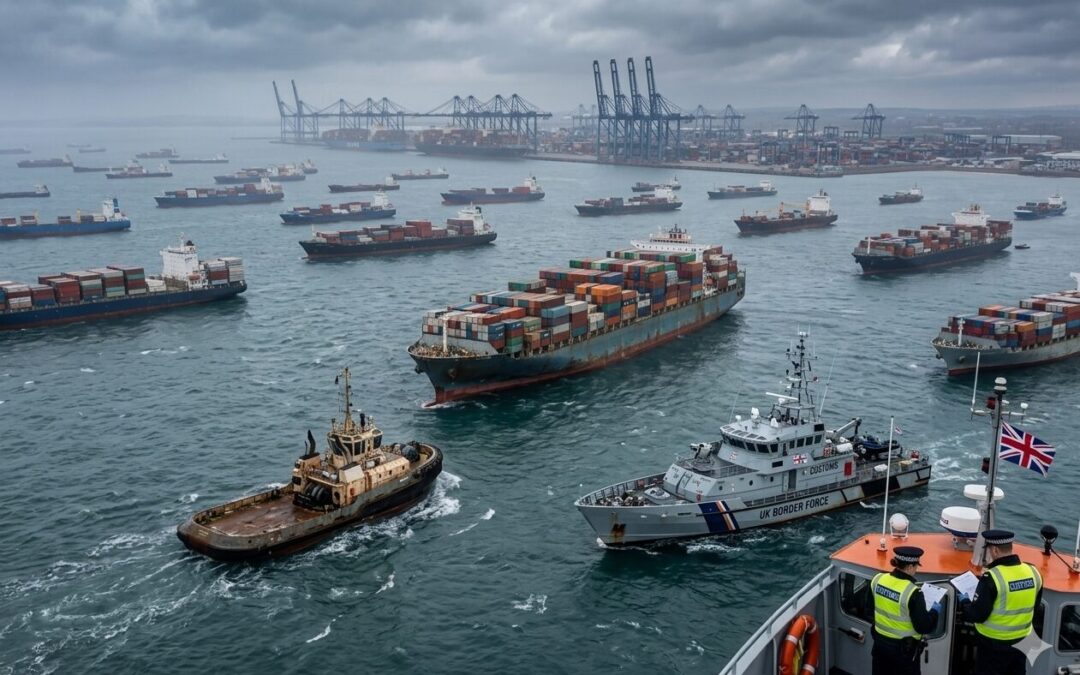
How to Respond When Global Shipping Routes Are Disrupted
How to respond when global shipping route disruption has moved from being a periodic shock to a permanent feature of global trade. Red Sea rerouting, Strait of Hormuz risk, Panama Canal capacity constraints, alliance restructuring, port congestion, and post-Brexit customs friction, and the need for logistics contingency planning are no longer separate stories. They are overlapping expressions of a more volatile operating environment in which UK supply chain leaders are now expected to perform.
The data tells the story plainly. Around 30% of global container trade transits the Suez Canal (J.P. Morgan Research), and roughly 11% of global trade and a third of seaborne oil pass through the Strait of Hormuz (UNCTAD). When those corridors come under pressure, the consequences ripple outward. UNCTAD reported that Suez Canal tonnage was around 70% below 2023 levels by May 2025, and that global ton-miles grew by approximately 6% in 2024, roughly three times faster than trade volume growth, as vessels rerouted to longer alternatives (UNCTAD Review of Maritime Transport 2025). For UK businesses, where around 95% of imports and exports move by sea (Statista, UK Department for Transport), this is not abstract macro detail. It is the daily reality shaping landed cost, lead time, and customer commitments.
Key takeaways
- Shipping disruption is now structural, not episodic. Treating each event as a one-off crisis leads to repeat firefighting.
- A useful response framework runs in three phases: Stabilise (first 72 hours), Adapt (short-term tactical) and Build (long-term structural).
- Trade-offs between cost, speed, carbon, and resilience are real. There is no option that improves every variable at once, and senior leaders should resist commercial promises that suggest otherwise.
- The strategic value of a global trade management partner sits less in any single shipment and more in the visibility, optionality, and considered advice they bring across the full picture.
Why is sea freight disruption now structural, not episodic?
Shipping disruption has shifted from a series of discrete events to a structural feature of global trade. Geopolitical risk, climate pressure on chokepoints, carrier alliance restructuring, infrastructure constraints, and tighter regulatory regimes now overlap rather than alternate. The result is a baseline level of volatility and shipping route disruption that supply chain strategy has to be designed around, not paused for.
Three forces are converging. The first is concentration risk on a small number of maritime chokepoints. The Suez Canal, the Strait of Hormuz, the Strait of Malacca, the Panama Canal, and the Bab al-Mandab strait carry a disproportionate share of global trade between them, and any sustained restriction on one route forces capacity elsewhere. UNCTAD figures showing global ton-miles growing roughly three times faster than trade volume in 2024 are the clearest evidence of this. Goods are travelling further, not because there are more goods, but because the shortest route is no longer available.
The second is the way carrier capacity is being reorganised. Alliance restructuring, vessel sharing changes, and shifting trade lanes mean the service map UK importers were planning around a few years ago is not the service map they are operating in today. The third is the compounding effect of post-Brexit customs friction on UK trade specifically, which adds a layer of administrative volatility that did not exist for European routes a decade ago. None of these forces are about to subside, and senior leaders should plan as though disruption is the operating environment, with calmer windows being the exception.
What should a UK business do in the first 72 hours of a major sea freight disruption?
In the first 72 hours of a major shipping route disruption, the priority is to stabilise: establish accurate visibility of exposed cargo, communicate clearly with customers and internal stakeholders, and triage decisions by criticality rather than by anxiety. The goal at this stage is not to fix the situation, which often cannot be fixed quickly, but to avoid avoidable losses while better options come into view.
The first task is exposure mapping. Which shipments are in transit on affected lanes, where exactly are they, what is the value and customer commitment attached to each, and what optionality exists at the next port of call? Many businesses discover at this point that their visibility is thinner than they assumed, particularly for cargo handled across multiple parties.
The second is internal and external communication. Senior decision-makers, sales teams, and key customers all need a single, consistent picture of what is known, what is not yet known, and when the next update will come. A short, factual update beats an ambitious one that has to be retracted.
The third is decision triage. Some cargo will need to keep moving at any reasonable cost, some can wait, and some should switch mode or be held in storage. The discipline at this stage is to make the decision the situation actually allows, then revisit it as the picture improves.
What tactical options exist when major shipping routes are disrupted?
When major shipping route disruption persists beyond the immediate window, the tactical playbook centres on rerouting, multimodal alternatives, off-dock storage, surcharge management, and customs flexibility. Each option carries a real trade-off, typically between cost, speed, and complexity. The right answer depends on cargo profile, customer commitments, and how long the disruption is expected to run.
Rerouting around an affected chokepoint is often the first lever. The Cape of Good Hope routing in place of Suez is the obvious recent example, with associated transit and fuel costs. Multimodal alternatives, including sea-air and sea-rail combinations, can compress recovered time on selected high-priority cargo, at materially higher unit cost. Off-dock storage and bonded warehousing give buffer when ports are congested or when import timing needs to be managed against demurrage and detention exposure.
Surcharge management is a quieter but significant area. Disruption typically triggers war risk insurance premiums, peak season surcharges, low sulphur surcharges, and emergency operational surcharges. Senior leaders should expect these to appear on invoices, scrutinise their basis, and negotiate where the framework allows. Customs flexibility matters in parallel: clearance regimes, deferred duty arrangements, and authorised economic operator status all affect how much room exists to move cargo through alternative ports.
The table below sets out the principal trade-offs by tactical option. Actual figures vary by lane, carrier, commodity, and contract, and should be modelled against your own data.
| Tactical option | Cost impact | Transit time | Complexity | Best fit |
| Rerouting via alternative corridor | Higher fuel and capacity costs | Longer transit | Moderate | Most cargo where time tolerance allows |
| Sea-air or sea-rail multimodal switch | Materially higher unit cost | Faster than rerouted sea | High | High-value or commitment-critical cargo |
| Off-dock or bonded storage | Storage and handling costs | Buys time, does not save it | Low to moderate | Demurrage exposure or congested ports |
| Surcharge negotiation and review | Potential cost recovery | No transit impact | Low | Any operator with structural carrier exposure |
| Customs and port flexibility | Lower friction cost | Reduces avoidable delay | Moderate | Importers with concentrated port reliance |
How can businesses build longer-term supply chain resilience?
Long-term supply chain resilience is built through structural choices: dual-sourcing or supplier diversification, considered near-shoring where the economics support it, integrated visibility across the supply chain, scenario-based logistics contingency planning, and partner selection that reflects the strategic weight of the function. Resilience is not a procurement project. It is the cumulative output of how the supply chain is designed.
Dual-sourcing is the most direct answer to single-supplier and single-route exposure. The trade-off is unit cost, since concentrated volume usually buys better pricing, set against the cost of failure when a sole source becomes inaccessible. Near-shoring sits in similar territory. Bringing parts of the supply base closer to UK demand can reduce lead time, transit risk, and currency exposure, at the cost of typically higher unit pricing and the operational work of qualifying new suppliers. The judgement is rarely all-or-nothing, and the better-run programmes tend to be selective, applying near-shoring to specific SKUs or categories where the resilience case is strongest.
Integrated visibility is the other strategic pillar. Disruption is far more manageable when the business can see, in close to real time, where cargo is, what is committed to it, and what optionality exists. This usually means consolidating data across freight forwarders, carriers, customs filings, and warehouse systems rather than treating each as a separate silo. Senior leaders should expect to invest in this capability over time, not buy it off the shelf.
Scenario-based logistics contingency planning ties these elements together. The aim is not to predict the next event accurately, it is to be ready for a small set of plausible scenarios, with pre-agreed triggers, decision rights, and partner playbooks. Done well, contingency planning compresses the first 72 hours of any future disruption from a scramble into a sequence the business already knows.
The role of a global trade management partner
A capable global trade management partner brings more than freight booking. The strategic value sits in the quality of advice, the breadth of multimodal options, the depth of customs and compliance capability, and the visibility that comes from coordinating across all of these in one view. For senior leaders, the question is less about who can move a container and more about who can help the business think clearly when the operating environment turns volatile.
Three capabilities tend to matter most when disruption is structural. The first is multimodal optionality across sea, air, road, and rail, so that response is not constrained by a single mode contract. The second is customs and trade compliance depth, particularly for UK businesses navigating post-Brexit complexity alongside global disruption effects. The third is integrated warehousing, distribution, and storage flexibility, which converts time pressure into a manageable inventory question rather than a freight crisis.
The right partner relationship looks more like advisory than vendor management: regular review of exposure, joint contingency planning, and candid conversation about trade-offs. That posture is hard to retro-fit during a disruption. It is built in calmer windows and called on when needed.
Frequently asked questions
– What causes sea freight disruption?
Sea freight disruption is caused by a combination of geopolitical risk on key maritime chokepoints, climate pressures on infrastructure such as canal water levels, carrier alliance restructuring, port congestion, labour disputes, and regulatory friction. UK supply chains are also exposed to post-Brexit customs requirements, which can compound the operational impact of upstream disruption.
– How do you balance cost, speed, and resilience when routes are disrupted?
No tactical option improves all three at once. The honest answer is to define the priority by cargo type and customer commitment, then accept the trade-off. High-margin or commitment-critical cargo earns the cost of speed. Lower-priority cargo absorbs longer transit. Resilience itself usually carries an ongoing cost in the form of dual-sourcing, buffer stock, or partner redundancy, and is best treated as a budgeted line rather than an emergency expense.
– How should logistics contingency planning be structured?
Effective logistics contingency planning is structured around plausible scenarios rather than specific predictions, with clear triggers, named decision-makers, and pre-agreed playbooks for each scenario. It should cover supplier failure, single-route closure, sustained capacity loss, and significant cost shock. Plans are reviewed at least annually with key partners, and lessons from each disruption cycle are written back into the playbooks.
Operating well in a disrupted system
The senior reader of this article is unlikely to be looking for reassurance, and the case for resilience is not made by drama. It is made by the patient observation that the shipping route disruption pattern is no longer an interruption to a stable system. It is the system. Businesses that internalise this shift, structure their planning accordingly, and build the partner relationships that support clear thinking under pressure will compete on better terms than those still treating each event as a surprise. The Stabilise, Adapt, Build framework is one way to organise that work, and a well-prepared operation moves through the sequence faster than one starting from scratch.
Talk to Uniserve about your exposure to shipping route disruption
Uniserve is the UK leading independent logistics and global trade management provider, part of GB Global, with multimodal sea, air, road, and rail capability, customs and compliance depth, and integrated warehousing and distribution. We work with senior supply chain leaders on the questions disruption raises rather than the products it sells.
If you would value a peer-level conversation about your specific exposure, your contingency planning, or how your current setup would perform in a sustained disruption, we would be glad to have it. Visit our UniOcean sea freight and global trade management pages to see how we work or get in touch directly to start a more tailored discussion.