
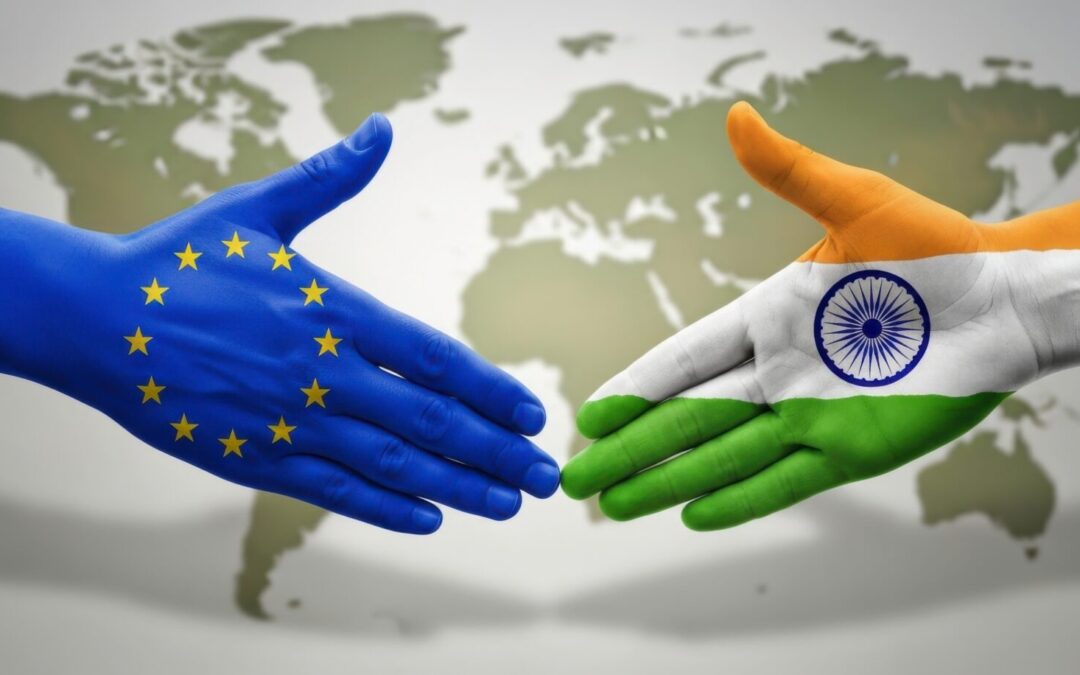
It was almost two decades in the making, but on Tuesday (January 27) India and the European Union finally struck the “mother of all deals”.
Hot on the heels of the UK-India free trade agreement signed last July, the landmark new pact aims to double EU exports to India by 2032, eliminating or reducing tariffs on almost 97 percent of traded goods by value. Brussels estimates EU companies could save €4 billion in duties.
Over the next seven years, the EU will reduce or remove tariffs on 99.5 percent of goods imported from India, spanning sectors from machinery to textiles and chemicals.
European Commission President Ursula von der Leyen and Indian Prime Minister Narendra Modi lauded the agreement as “historic,” a show of unity amid swingeing U.S. tariffs.
For shippers and logistics operators, however, the deal’s significance is likely to be practical rather than political, with a focus on freight volumes, capacity and compliance rather than immediate disruption.
Rate rises
Most tariff reductions will be phased in, meaning freight volumes are unlikely to be transformed overnight.
While the deal is expected to unlock new trade over time, increased volumes could place pressure on freight rates, rather than reduce them.
“If cheaper trade means increased volumes, then the more likely outcome is that shipping costs will be higher,” Uniserve’s Air Freight Director Leighton Bonnett says. Over time, he adds, the agreement will “likely attract more capacity into the market.”
A similar principle is applied at sea: there is no automatic mechanism linking lower tariffs to lower ocean freight rates.
Uniserve’s Ocean Commercial Director Scott Baker explains: “If trade stimulation is effective and demand grows, freight prices could rise rather than fall.”
Greater predictability in trade flows may also encourage a shift away from spot bookings towards longer-term ocean freight contracts, he adds, particularly where volumes increase between international buyers and sellers.
Air and ocean capacity
As bilateral trade expands, air freight volumes are expected to grow in percentage terms, particularly for higher-value or time-sensitive goods.
The India-UK agreement signed last year offers a useful benchmark. Capacity between the two markets — mainly supported by cargo on passenger flights — can comfortably handle current volumes, Leighton says.
For now, eastbound air capacity from Europe to India is expected to remain sufficient, although some rate volatility is likely as demand increases. Westbound volumes are also considered manageable.
On the ocean side, concerns around port congestion appear limited, at least initially.
“The Europe-India trade lane currently is steady and consistent, capacity is available, and shipping lines will warm to an increase in volume – should it develop,” Scott says.
Seasonal pressure does occur – such as with grape season – but capacity has generally remained available even during busy weeks.
Any increase in eastbound volumes would be a “warm welcome” to the sector, Scott says, given the “heavy imbalance between imports and exports on the route.”
Operation impact
The agreement is not expected to significantly alter day-to-day shipping operations, but customs compliance will be critical to securing preferential tariffs.
Reduced duty rates will depend on meeting specific eligibility criteria and compliance requirements. While border clearance is unlikely to slow, post-clearance audits are expected to increase as authorities verify tariff claims.
From an ocean logistics standpoint, demand growth driven by the deal is not expected to strain operations in the near term.
With European consumption projected to remain flat, any near-term volume growth is not expected to strain ports or transport networks.