
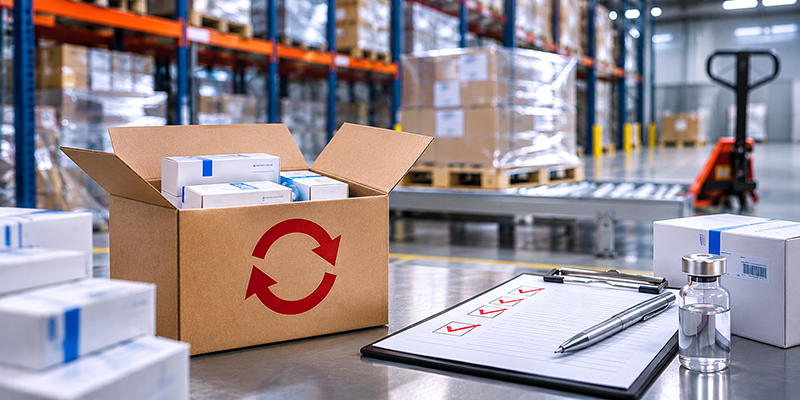
Pharma reverse logistics is the controlled process of managing returned, recalled, damaged or quarantined pharmaceutical products while maintaining full traceability, regulatory compliance and product integrity.
Nothing about a return is casual in this industry
In most retail categories, a return is a mild inconvenience with a fairly forgiving set of rules. In pharma, a return is a regulated event with a specific, documented path, and the wrong path can turn a routine stock movement into a compliance failure. The MHRA GDP Inspectorate has been explicit about what actually qualifies a returned medicine to go back into saleable stock: the product must be in unopened, undamaged packaging, must not have expired or been recalled, there must be evidence it was transported and stored correctly throughout, and it must be assessed by someone trained and authorised to make that call. Miss any one of those conditions and the product’s journey back into the supply chain looks very different. Uniserve’s healthcare and pharma logistics experience covers exactly this kind of controlled reverse flow, not just the forward journey most logistics conversations focus on.
The sorting room nobody talks about
Every returned pharmaceutical product enters what is, in effect, a sorting room, whether that is a literal quarantine area or a documented digital process achieving the same thing. What happens next depends entirely on why the product is coming back. Pharma reverse logistics is really five different processes wearing one label, and treating them as interchangeable is where most compliance risk creeps in.
Forward logistics gets the strategic attention because it is where revenue moves. Reverse logistics gets treated as a cost centre to be minimised, which is exactly backwards given how much regulatory exposure sits inside it. A business can run a flawless forward supply chain for years and still fail an inspection because its returns process was never designed with the same rigour.
It expired on the shelf
Expired stock is the most predictable category of pharma reverse logistics and, ironically, one of the easiest to get wrong through simple neglect. A product past its expiry date cannot be resold or redistributed, full stop, but it still needs to be tracked, segregated and disposed of through an approved route, with documentation proving it never re-entered the legitimate supply chain by accident. Healthcare reverse logistics processes that treat expired stock as low priority housekeeping, rather than a controlled disposal event, are where audit findings most often start.
The fix is almost entirely procedural rather than technical. Regular, disciplined stock rotation reduces how much expired inventory ever accumulates in the first place, and a clear, unambiguous segregation area stops expired stock sitting near saleable product where a picking error becomes a genuine risk rather than a paperwork inconvenience.
It got recalled
A recall changes the entire tempo of reverse logistics. Instead of a predictable, scheduled process, a business needs to identify every affected batch across every location it has reached, often within a tight regulatory timeframe, and pull it back through the network with full traceability. Pharma recalls logistics depends entirely on how good the forward traceability was in the first place. A business that cannot quickly answer where a specific batch is right now has no realistic chance of executing a fast, complete recall when it matters most.
Speed and completeness are both being judged simultaneously during a recall. A fast but incomplete recall leaves compromised stock in circulation. A complete but slow recall extends the window of patient risk. Neither outcome is acceptable, which is why recall readiness is really a test of everyday traceability discipline rather than something that can be assembled quickly once a recall notice actually arrives. Getting this category right is one of the clearest tests of whether pharma reverse logistics has actually been designed properly, rather than assembled only once a recall notice forced the question.
It arrived damaged
Damage in transit triggers a straightforward but non negotiable rule: damaged secondary packaging disqualifies a product from saleable stock, regardless of whether the product inside is probably still fine. Pharmaceutical returns of this kind need to be quarantined immediately, assessed by a trained and authorised person, and either destroyed or returned to the supplier through an agreed process. The temptation to make a judgement call and reshelve a product that looks fine is exactly the kind of shortcut GDP exists to prevent.
This category is also a useful diagnostic. A spike in damaged returns from one route, one carrier, or one handling point is rarely bad luck repeating itself. It is usually a specific, fixable weakness in the forward journey showing up as a reverse logistics cost, which makes damaged returns worth tracking by cause, not just by volume. Treating damaged stock with this level of consistency is a small but telling sign of mature pharma reverse logistics, since the easy shortcut is exactly what a rushed process reaches for first.
It was never meant to be there
Order errors, wrong quantities, and misdirected deliveries create a category of medical product returns that is procedurally simple but easy to under-resource. The product itself may be perfectly fine, still within its validated conditions and never actually delivered to the wrong end customer, but it still needs a documented return path back into stock rather than an informal shuffle between locations that leaves no clean audit trail.
The risk with this category is complacency. Because the product is usually genuinely fine, it is tempting to wave it back into stock without the same formal check applied to other return types. Consistency matters more than the specific product’s condition here. A process with exceptions for the easy cases is a process that eventually has an exception in the wrong place. Even the simplest category of pharma reverse logistics still deserves the same documented rigour as the more dramatic ones, precisely because it is where shortcuts are easiest to justify.
It broke temperature
A confirmed or suspected temperature excursion is the most consequential reason a product comes back, because unlike physical damage, a temperature failure is often invisible without the monitoring data to prove it happened. Many wholesalers will not consider temperature sensitive returns for resale under any circumstances, given the difficulty of proving conclusively that the product remained within its validated range for its entire journey. These returns typically move straight to a dedicated quarantine area pending supplier investigation, rather than any assessment aimed at getting them back into saleable stock at all.
This is the category most directly tied to the quality of upstream monitoring. A shipment with continuous, verifiable temperature data gives a quality team something concrete to assess. A shipment with a data logger nobody checked until the product had already been unpacked gives them only uncertainty, and uncertainty in this category defaults to loss rather than benefit of the doubt. This is arguably where pharma reverse logistics earns its reputation as a genuinely regulated discipline rather than a back office tidy-up exercise.
Where every return actually goes
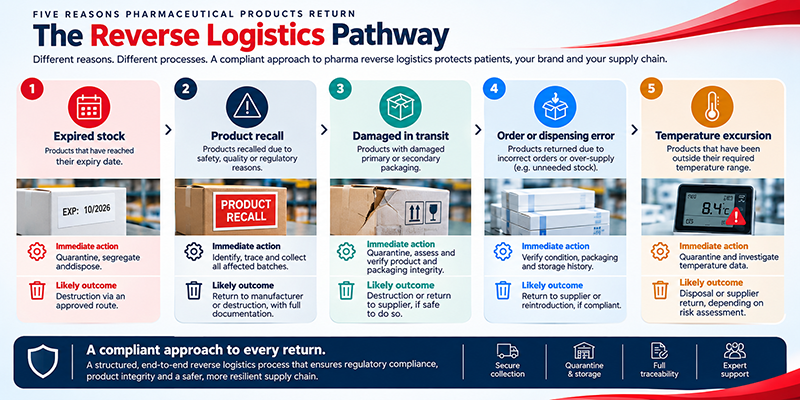
Pulling the five reasons into a single view makes the pattern clear: the reason a product comes back determines almost everything about how it needs to be handled next. Very few of these paths lead back to the shelf, which is worth remembering when budgeting reverse logistics capacity. Most controlled product flows in pharma end in destruction or supplier return, not resale, and planning as though resale were the default outcome tends to leave quarantine and disposal capacity permanently under-resourced. Seeing all five paths together is a useful reminder that pharma reverse logistics is rarely a single process wearing different labels. It is five distinct decisions, each with its own evidence requirements.
| Reason for return | Immediate action | Typical outcome |
| Expired stock | Segregate, document, route to approved disposal | Destroyed through an approved, auditable route |
| Recalled batch | Identify all affected stock, pull back with full traceability | Returned to manufacturer or destroyed per recall instructions |
| Damaged in transit | Quarantine immediately, assess by authorised person | Destroyed or returned to supplier, rarely resold |
| Order or delivery error | Document the error, formal return to stock | Returned to saleable stock once verified |
| Temperature excursion | Quarantine pending investigation | Usually not returned to saleable stock |
Why reverse logistics needs the same rigour as forward logistics
It is tempting to treat returns as a smaller, lower stakes version of the forward supply chain. The opposite is usually true. A returned product carries more uncertainty, not less, and needs storage that can hold it securely while its status is resolved. Quarantine and controlled storage built for exactly this purpose, within facilities equipped for regulated and bonded goods, keeps uncertain stock physically and procedurally separate from saleable inventory until a decision is actually made, rather than sitting in ambiguity on a general shelf.
Visibility matters just as much in reverse as it does forward. Knowing exactly where a batch is, and being able to prove it, is what makes a fast recall possible in the first place. Real time tracking, of the kind built into Uniserve’s One World platform, turns a recall from a frantic, manual search into a structured, traceable process with a clear start and end point. Getting this right consistently is what separates pharma reverse logistics done as a genuine discipline from returns handling treated as an afterthought bolted onto the forward supply chain.
Frequently asked questions
Can returned medicines be resold?
Only if strict conditions are met: unopened and undamaged packaging, no expiry or recall, proven correct transport and storage throughout, and assessment by a trained, authorised person. Most returns do not meet all four conditions.
What happens to recalled pharmaceutical stock?
Recalled stock is identified across every location it has reached, pulled back through the network with full traceability, and then destroyed or returned to the manufacturer according to the specific recall instructions issued.
How long can a business hold returned medicines before disposal?
There is no single fixed timeframe. It depends on the reason for return, the product, and internal quality procedures, though best practice is to resolve a return’s status promptly rather than letting quarantine stock accumulate indefinitely.
Does damaged packaging always mean a product must be destroyed?
Not always, but damaged secondary packaging disqualifies a product from saleable stock under GDP regardless of the product’s apparent condition. The outcome typically depends on assessment by a trained, authorised person and any supplier agreement in place.
What documentation is needed for pharma product returns?
Records should confirm the reason for return, storage and transport conditions during the product’s journey, the assessment outcome, and the final disposition, whether that is restocking, return to supplier, or destruction.
What happens during a pharmaceutical product recall?
A recall starts with identifying every location an affected batch has reached, using traceability data to pull back the full trail rather than relying on partial records. Once identified, the stock is quarantined immediately, removed from anywhere it could still be sold or administered, and handled according to the specific instructions issued for that recall, whether that means return to the manufacturer or destruction. Speed and completeness are judged together throughout, since a fast but incomplete recall still leaves compromised stock in circulation. How well this goes almost entirely reflects how good everyday batch traceability already was, not anything specific to the recall itself.
The bottom line on getting returns right
Pharma reverse logistics is not a smaller version of forward logistics run in reverse. It is its own discipline, with its own decision points, and the businesses that handle it well are the ones that built a documented path for each of the five reasons above before they needed it, not while a recall clock was already running. Providers holding Wholesale Distribution Authorisation bring exactly this kind of structured discipline to returns handling, treating it as a regulated process rather than an operational afterthought.
Talk to Uniserve about pharma reverse logistics
If returns, recalls or quarantine stock have become harder to manage cleanly as volumes grow, it is worth reviewing whether your current process actually distinguishes between the five reasons products come back, or treats them all the same. We can help build controlled, traceable reverse flows into your existing pharma logistics operation. Contact Uniserve’s team to discuss your pharma reverse logistics needs.