

Healthcare Supply Chain Visibility: Why Real-Time Control Matters for Regulated Products
Healthcare supply chain visibility is the ability to monitor the location, condition and status of regulated products in real time, enabling organisations to identify issues early, maintain compliance and make informed operational decisions.
You cannot manage what you cannot see
Ask a supply chain director where a specific shipment is right now, and the honesty of the answer tells you almost everything about their operation’s maturity. Some will tell you exactly where it is, what temperature it has held, and when it is due. Others will tell you where it was supposed to be as of yesterday’s report. Healthcare supply chain visibility is not a single feature a business either has or does not have. It is a ladder, and most organisations are somewhere in the middle of it without having consciously decided to be. Peer-reviewed research citing World Health Organization estimates has linked more than half of vaccine wastage in some settings to breakdowns in maintaining the 2°C to 8°C cold chain range, and a meaningful share of that traces back not to bad equipment, but to nobody actually watching the data closely enough to catch the problem in time. Uniserve’s healthcare and pharma logistics capability is built around closing exactly that gap.
Four stages, and most businesses are stuck between two of them
Pharma supply chain visibility tends to develop in a predictable sequence, and naming the stages makes it much easier to see where your own organisation actually sits, rather than where you assume it sits. What follows is that ladder, from the bottom rung to the top.
It is worth being honest about why this matters more in healthcare than almost anywhere else. A delayed parcel of clothing is an inconvenience. A delayed or compromised batch of medicine is a patient safety question with a regulator watching how it gets answered. Pharma logistics visibility is not a nice to have layered on top of a working supply chain. For regulated products, it is close to being the supply chain’s actual safety mechanism, not a reporting feature bolted onto the side of one. This is exactly why healthcare supply chain visibility deserves board level attention rather than being treated as a back office reporting concern.
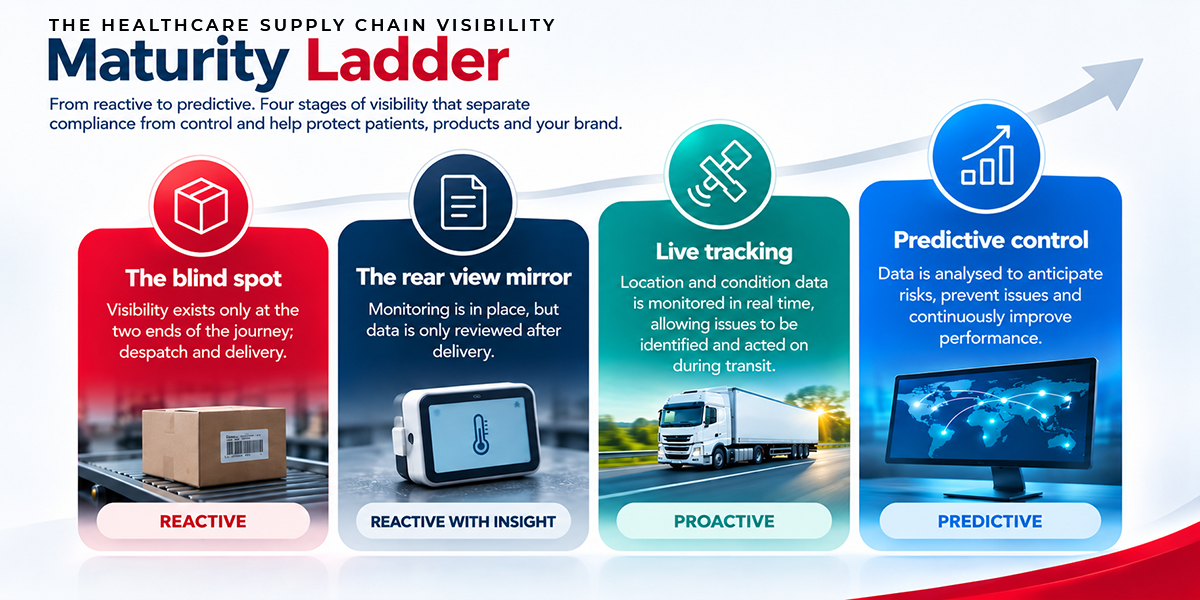
Stage one: the blind spot
At the bottom of the ladder, visibility exists only at the two ends of a journey: despatch and delivery. What happens in between is a black box, assumed to be fine unless something arrives visibly wrong. Businesses at this stage are not being careless. They simply have no mechanism to know any different, which means every problem is discovered after the fact, often by the customer rather than the supplier.
This stage is more common than the industry likes to admit, particularly among smaller distributors and newer entrants who have simply never had a reason to invest beyond proof of delivery. It is not a comfortable place to operate from, but it is at least an honest one, since nobody at this stage is under any illusion that they have real visibility. The businesses genuinely at risk are the ones who assume they have moved past stage one without actually checking. Businesses without genuine healthcare supply chain visibility at this level are not exposed occasionally. They are exposed by default, on every single shipment.
Stage two: the rear view mirror
The next stage adds monitoring, usually in the form of data loggers or basic tracking, but the data only gets reviewed after delivery. This is a genuine improvement over stage one, because problems become visible and documented. It is still fundamentally reactive. Healthcare logistics tracking at this stage produces excellent records of what went wrong, but essentially no ability to have prevented it, since nobody was watching while there was still time to act.
Most regulated businesses land here first, often because it is the minimum a GDP inspection genuinely requires: evidence that conditions were monitored throughout a journey. That evidence is valuable for compliance and almost worthless for prevention, which is the uncomfortable trade off stage two represents. It satisfies the auditor while doing very little for the patient waiting on the product actually arriving intact. This is the point where many organisations mistakenly believe their healthcare supply chain visibility is already mature, simply because monitoring equipment is present somewhere in the process.
Stage three: live tracking
Stage three is where visibility starts to earn its name properly. Location and condition data flow continuously, checked during transit rather than only afterwards, through platforms such as Uniserve’s One World technology. A deviation is caught while a shipment is still moving, which converts a guaranteed loss into a possible save. This is the stage where end-to-end supply chain visibility genuinely starts to function as a working safety net rather than a record keeping exercise.
The operational shift required to reach this stage is bigger than the technology purchase involved. Live data is only useful if someone is actually assigned to watch it and empowered to act on what they see, which means stage three is as much a staffing and process decision as a monitoring one. A business can buy the sensors and still operate at stage two in practice if nobody owns the dashboard. Reaching this point is what separates genuine healthcare supply chain visibility from monitoring theatre, where sensors exist but nobody is actually accountable for watching them.
Stage four: predictive control
The top of the ladder uses live data not just to catch problems as they happen, but to anticipate where they are likely to happen next. A route with a pattern of delays, a depot with a history of dwell time issues, a carrier whose vehicles run warmer than most, all become visible as patterns rather than isolated incidents. Very few healthcare supply chains genuinely operate at this stage consistently, which is less a criticism and more a reflection of how much disciplined data history it actually requires to get there.
Reaching stage four is less about a single piece of technology and more about time and consistency. A business needs enough history of live, stage three data before patterns become reliable enough to act on with confidence, which is exactly why organisations that jump straight from stage one to claiming stage four capability rarely have the substance to back it up. The ladder does not have a shortcut past its middle rungs. Very few organisations can honestly claim healthcare supply chain visibility at this level, and fewer still can prove it with real historical data rather than a confident assertion.
The visibility ladder at a glance
| Stage | What it looks like | Core limitation |
| Blind spot | Visibility only at despatch and delivery | Every problem is discovered after the customer does |
| Rear view mirror | Data collected but reviewed only after delivery | Evidence exists, but the chance to act is already gone |
| Live tracking | Continuous monitoring, checked during transit | Reactive but timely, catching issues while fixable |
| Predictive control | Live data used to anticipate recurring risk | Requires sustained data history and disciplined analysis |
What real control actually buys you
Moving up this ladder is not just an operational nicety. For regulated products, visibility is what turns a compliance obligation from a paperwork exercise into something genuinely defensible. Being able to show an inspector, a regulator or a customer exactly what happened to a specific batch, with continuous evidence rather than a plausible reconstruction, changes the entire tone of that conversation.
It also changes what a business can promise commercially. A team with stage three or four visibility can give a customer an honest, specific answer about a delayed shipment while it is still in transit. A team stuck at stage one or two can only apologise after the fact. Over time, that difference shapes which supplier a demanding healthcare customer chooses to keep working with.
There is a quieter benefit too. Teams operating with genuine live visibility spend noticeably less time firefighting, simply because far fewer problems are allowed to fully develop before someone notices. The hours saved rarely show up as a line item anywhere, which is probably why this benefit gets undersold compared to the more visible cost of the technology itself. This is ultimately what healthcare supply chain visibility is for: not just cleaner reporting, but fewer problems that ever need reporting on in the first place.
Frequently asked questions
What is healthcare supply chain visibility?
Healthcare supply chain visibility is the ability to see, in real time, where a product is and what condition it is in as it moves through storage and transport, rather than only confirming its status at despatch and delivery.
Why does real-time visibility matter more for regulated products?
Regulated products carry compliance and patient safety implications that ordinary goods do not. Being able to prove exactly what happened to a specific batch, continuously, is often a regulatory expectation rather than a convenience.
What is the difference between tracking and visibility?
Tracking usually refers to knowing a shipment’s location. Visibility is broader, covering condition data such as temperature alongside location, and whether that information is available in real time or only after the fact.
How is predictive visibility different from live tracking?
Live tracking shows what is happening right now. Predictive visibility uses historical patterns in that data, such as a route with recurring delays, to anticipate where problems are likely before they actually occur.
What technology supports pharma supply chain visibility?
Continuous monitoring platforms, GPS and condition tracking on vehicles, and integrated data systems that connect warehousing and transport all contribute, though the technology only delivers real visibility if the data is actively monitored, not just recorded.
Climbing the ladder without pretending you are already at the top
The most common mistake is not being at stage one or two. It is assuming you are further up the ladder than you actually are, because a monitoring system exists somewhere in the business even if nobody consistently watches it in real time. Facilities such as Uniserve’s Felixstowe distribution centre, built with temperature-controlled and ambient capacity under continuous monitoring, only deliver genuine stage three or four visibility when the data they generate is actually being watched and acted on, not simply stored as a record of what already happened. Real healthcare supply chain visibility only exists once that data is genuinely being watched, not just generated.
Talk to Uniserve about healthcare supply chain visibility
If you are not entirely sure which stage of this ladder your own operation genuinely sits on, that uncertainty is itself useful information. We can help map your current visibility against all four stages and close the gap to real-time, actionable control. Contact Uniserve’s team to discuss your healthcare supply chain visibility needs.
Healthcare supply chain visibility is the ability to monitor the location, condition and status of regulated products in real time, enabling organisations to identify issues early, maintain compliance and make informed operational decisions.