

GDP-Compliant Logistics Explained: What Healthcare and Pharma Supply Chains Need to Know
GDP-compliant logistics is the regulated process of storing, transporting and distributing pharmaceutical products while maintaining their safety, quality and traceability throughout the supply chain.
Follow the box
A small cardboard box leaves a manufacturing plant. Inside it is a batch of medicine that will, if everything goes right, end up in a patient’s hand within a few days. Nobody at the pharmacy counter will ever see the vehicle it travelled in, the warehouse it passed through, or the paperwork that followed it every step of the way. But if any one of those links breaks quietly enough, the medicine that arrives may not be the medicine that left. That gap between what should have happened and what actually happened is exactly what Good Distribution Practice, or GDP, exists to close.
The stakes are not abstract. The World Health Organization estimates that 1 in 10 medical products circulating in low and middle income countries are substandard or falsified, costing an estimated 30.5 billion US dollars a year and, in the worst cases, costing lives. Strong regulation and disciplined logistics are a large part of why that failure rate is so much lower in markets like the UK. GDP compliant logistics is the discipline that keeps it that way, and Uniserve operates its healthcare and pharma logistics services through a GDP standardised and certified network built around exactly this responsibility. This guide follows one box through five checkpoints to show what that actually looks like in practice.
Quick version, before the story starts
- GDP compliant logistics covers everything that happens to a medicine after manufacture, including storage, transport, documentation and who is allowed to handle it.
- It applies to wholesalers, distributors and logistics providers, not only manufacturers, and in the UK is overseen by the MHRA.
- Good distribution practice logistics is built on five pillars: quality management, personnel, documentation, premises and transport, and control of outsourced activities.
- Most compliance failures do not happen at one dramatic point. They accumulate quietly across several of these pillars at once.
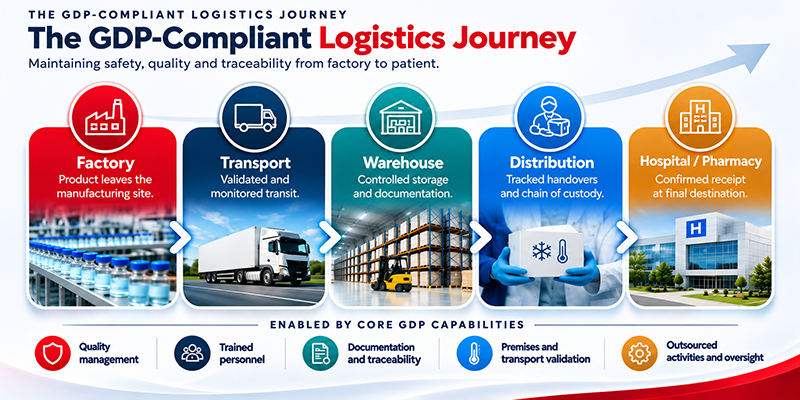
Chapter one: leaving the factory gate
The moment a batch of medicine leaves a manufacturing site, responsibility shifts. Good Manufacturing Practice, GMP, governs how the product was made. From this point forward, GDP governs everything else: how it is stored, how it moves, who touches it, and how all of that is recorded. In the UK this sits under the Human Medicines Regulations, aligned with the European Commission’s GDP guidelines, and enforced by the Medicines and Healthcare products Regulatory Agency, the MHRA.
This handoff is where the first quality management decisions get made, often invisibly. A wholesaler or logistics provider receiving the batch needs a documented quality management system already running before the box arrives, not one assembled afterwards to explain what happened. Pharma GDP compliance starts with this discipline, applied consistently, long before anyone is checking for it. Think of it as the difference between a business that can produce evidence on request and one that has to reconstruct a story after the fact. Inspectors, and increasingly commercial buyers too, can usually tell the difference within minutes. This is the discipline that genuine GDP compliant logistics is built on: evidence that already exists, not evidence assembled after someone asks for it.
Chapter two: the vehicle that isn’t just a van
To the outside world, the vehicle carrying that box looks like any other delivery van or truck. Under GDP transport rules, it is a validated, monitored environment with its own qualification record, proving it can hold the conditions the product needs for the length of the journey. Documentation travels with the shipment, not behind it, recording where the batch has been and confirming nothing about its custody is in question. This is where real-time visibility platforms earn their keep, since a gap in tracking data during transport is exactly the kind of thing a GDP inspector, and a cautious buyer, will ask about directly.
None of this is about temperature control alone, although that is often where people’s minds go first. A shipment that never needs refrigeration still has to be protected from contamination, mix-up and unauthorised access, and still needs a documented chain of custody covering every hand it passes through. None of this happens by accident. GDP compliant logistics treats the vehicle itself as part of the regulated chain, not simply a way of moving the box from one point to another.
Chapter three: the warehouse with a paper trail
Inside the distribution centre, the box joins a much larger operation built around the same principle: nothing moves without a record. Batch numbers are tracked, storage locations are logged, and the facility’s quality management system, referred to in Uniserve’s own healthcare and pharma capability as its safety and compliance care management system, governs how deviations are recorded and corrected rather than quietly worked around.
This is also where most compliance failures actually surface. In its published 2016 GDP inspection deficiency data, the MHRA’s GDP Inspectorate found that Quality Systems and Transportation were consistently among the most frequently cited categories of major deficiency across UK inspections. In other words, the warehouse’s paperwork and the vehicle’s handling are where scrutiny lands hardest, which is exactly why healthcare logistics compliance has to be built into daily operations rather than assembled for inspection day. This is the part of GDP compliant logistics that inspectors trust least when they only see it emerge shortly before a visit.
Chapter four: who’s allowed to touch it
Not every logistics company is legally permitted to store or distribute medicines. In the UK, a business needs a Wholesale Distribution Authorisation, a WDA, granted by the MHRA after a rigorous inspection of its quality systems and processes. Within that structure, a named Responsible Person carries personal accountability for GDP compliance at the site, expected to be genuinely contactable and involved, not a name on a certificate.
Uniserve holds this accreditation directly. When the company was awarded its Wholesale Distribution Authorisation, it became one of a relatively small number of UK logistics providers recognised as having the correct quality systems in place for storing and distributing pharmaceuticals, a status that has to be maintained through ongoing risk-based inspection rather than earned once and forgotten. Holding this accreditation is what allows a business to describe its own operation honestly as GDP compliant logistics, rather than simply general freight handling medicines carefully.
Chapter five: the last mile and the final signature
The final stretch of the journey, from distribution centre to pharmacy or hospital, is often where chain of custody is weakest, simply because it involves the most handovers in the shortest space of time. A GDP compliant last mile closes that gap with the same discipline applied everywhere else: validated transport conditions, documentation that matches the physical delivery, and a confirmed receipt that closes the loop rather than assuming it closed itself. Small, local deliveries can feel low risk precisely because they are routine, which is exactly when shortcuts are most tempting and least visible.
The box that left the factory gate at the start of this journey should be recognisably the same box, in the same condition, with a complete record behind it, when it is finally signed for. That continuity, unbroken from end to end, is the entire point of GDP. That final signature is where GDP compliant logistics is actually judged in practice, as much as anywhere earlier in the journey.
The five pillars, mapped to the journey
Every stage above maps back to a small number of formal GDP pillars. This table connects the story to the structure, for anyone who needs the reference version. Seeing all five pillars together is a useful reminder that GDP compliant logistics rests on all of them holding at once, not just the one or two that happen to be easiest to demonstrate.
| Pillar | Where it showed up in the journey | What it means in practice |
| Quality management | Chapter one and three | A documented system for responsibilities, risk and deviation, running continuously rather than assembled for inspection |
| Personnel | Chapter four | Trained staff and a named Responsible Person with real authority and accountability |
| Documentation | Chapters two and three | Records that travel with the product and match what actually happened, not what should have happened |
| Premises and transport | Chapters two and three | Validated storage and vehicles, qualified to hold the conditions the product needs |
| Outsourced activities | Chapter five | Clear control and accountability wherever a third party is involved in the chain |
When the journey breaks down
It is tempting to treat GDP as a box-ticking exercise, right up until something goes wrong. A missed temperature record, an untrained handler, a shipment that changed hands without documentation. None of these individually sounds catastrophic. Together, repeated across a supply chain at scale, they are how substandard and falsified products end up reaching patients, and why regulators treat good distribution practice logistics as patient safety infrastructure rather than paperwork.
The commercial cost is real too. A failed GDP inspection can suspend a wholesale licence, halt shipments, and damage a relationship with manufacturers and healthcare providers that took years to build. Compliance is rarely the most exciting line in a logistics contract. It is consistently one of the most consequential, and it tends to be the line item nobody remembers to ask about until the day it matters most. This is precisely why GDP compliant logistics has to be treated as an ongoing operating discipline rather than a compliance box ticked once a year.
Five things people get wrong about GDP
A surprising amount of confusion about GDP compliant logistics comes down to a handful of persistent assumptions. Clearing them up tends to make the whole subject far less intimidating than it first appears.
“GDP is mainly about keeping things cold”
Temperature control is part of it for some products, but GDP covers the full picture: documentation, personnel, premises, transport and quality management, whether or not refrigeration is involved.
“GDP only applies to manufacturers”
GDP governs everything after manufacture. Wholesalers, distributors, brokers and logistics providers handling medicines are all in scope, which is exactly why a logistics partner’s own compliance matters so much.
“If a product isn’t refrigerated, GDP doesn’t really apply”
Ambient medicines still need controlled, validated conditions, accurate documentation and authorised handling. GDP transport rules are not limited to cold chain products.
“Any competent logistics provider can handle pharma”
In the UK, storing or distributing medicines requires a Wholesale Distribution Authorisation from the MHRA, granted only after inspection. General logistics competence does not substitute for this accreditation.
“Once you’re certified, you’re compliant for good”
GDP certificates are maintained through ongoing, risk-based inspection, not awarded once and left unchecked. Compliance is a continuous operating standard, not a one-off achievement.
Frequently asked questions
What does GDP stand for in pharmaceutical logistics?
GDP stands for Good Distribution Practice. It is the regulatory framework governing how medicines are stored, transported and handled after manufacture, covering everything from documentation and personnel to premises and transport conditions.
Is GDP the same as GMP?
No. GMP, Good Manufacturing Practice, governs how a medicine is made. GDP governs everything that happens to it afterwards, including storage, transport and the personnel and documentation involved in moving it through the supply chain.
Do all logistics companies need a Wholesale Distribution Authorisation?
Only businesses storing or distributing medicines need a WDA, granted by the MHRA after inspection. A logistics provider without this accreditation is not legally permitted to handle pharmaceutical products, regardless of their general logistics competence.
What products are covered by GDP compliant logistics?
GDP applies to licensed human and veterinary medicines moving through wholesale distribution. It does not typically cover medical devices, which sit under separate UK regulations, even though the two often move through similar healthcare logistics networks.
How often does the MHRA inspect for GDP compliance?
Inspections follow a risk based cycle rather than a fixed calendar, with frequency influenced by a site’s history, the nature of the products handled and any previous deficiencies. A licensed site should expect ongoing, recurring inspection rather than a one-off assessment.
The bottom line
GDP compliant logistics is not a separate department bolted onto a supply chain. It is the discipline that decides whether the medicine a patient receives is genuinely the medicine that left the factory, unchanged and unbroken in custody. Healthcare and pharma buyers evaluating a logistics partner are really asking one question at every stage of that journey: can this business prove, with a straight face and a complete record, exactly what happened to my product between these two points. Partners who can answer that consistently are the ones worth building a long-term relationship with.
Talk to Uniserve about GDP-compliant logistics
If GDP compliance, documentation or chain of custody has become a growing concern in your healthcare or pharma supply chain, it is worth reviewing whether your current logistics partner can account for every stage of the journey. We hold Wholesale Distribution Authorisation and operate a GDP standardised, certified network built for exactly this responsibility. Contact Uniserve’s team to discuss your GDP-compliant logistics needs.
GDP-compliant logistics is the regulated process of storing, transporting and distributing pharmaceutical products while maintaining their safety, quality and traceability throughout the supply chain.