
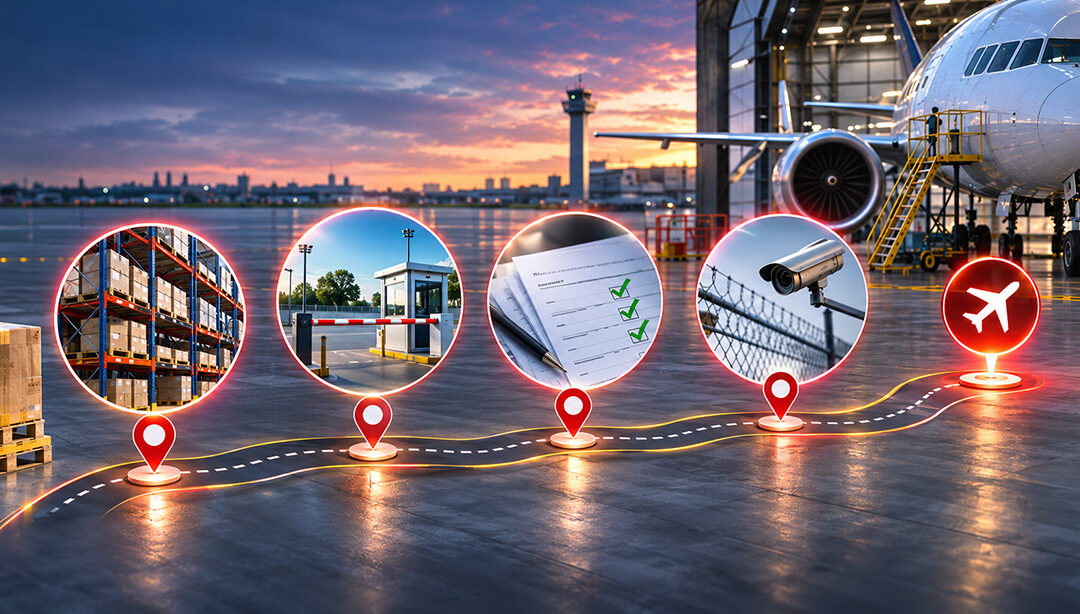
Every flight has a flight plan. Does your supply chain?
Pilots do not take off without a route mapped out in advance, waypoint by waypoint, with contingencies for the ones most likely to cause trouble. Aerospace supply chains rarely get the same treatment, even though the stakes are arguably just as high. Aerospace supply chain risk is not one problem. It is a series of distinct failure points strung across a single journey, from a part sitting in a warehouse to the moment it is fitted to an aircraft, and each point on that route has its own way of going wrong.
The pressure behind this has become impossible to ignore. IATA estimates that supply chain challenges will cost the airline industry more than 11 billion US dollars in 2025, driven by delayed fuel savings, higher maintenance costs and ballooning spares inventory. This guide maps the route, point by point, so the risk is visible before it grounds anything.
Key takeaways
- Aerospace supply chain risk shows up at distinct, identifiable points, not as one vague, diffuse threat.
- Parts availability and lead times are currently under more strain than at almost any point in recent industry history.
- Documentation and customs failures rarely ground an aircraft directly, but they are consistently what turns a delay into a much longer one.
- AOG risk sits at the end of this route, and it is where every upstream weakness eventually shows up as cost.
- Mapping these points in advance is what separates a business that manages aerospace logistics risk from one that simply reacts to it.
Waypoint one: parts availability
The starting point of the map is also, right now, its most congested. Aircraft deliveries fell to just 1,254 in 2024, roughly 30% below pre-pandemic levels, while the global order backlog has swelled to a record 17,000 jets, according to IATA’s aviation supply chain analysis. Airlines are responding by stockpiling parts defensively, which IATA estimates added 1.4 billion US dollars in extra spares inventory costs in 2025 alone. When the part simply is not available, everything downstream on this route becomes irrelevant.
This is aerospace supply chain management at its most fundamental: not moving parts efficiently, but knowing which parts are genuinely scarce before that scarcity becomes an emergency. Stockpiling is a rational response to this kind of aerospace supply chain risk, but it is also an expensive one, and it only works if a business has accurate enough visibility to know what to stockpile in the first place. A warehouse full of the wrong spares is its own kind of failure, just a quieter and more expensive one than an empty shelf.
Waypoint two: customs and border checkpoints
Every border a part crosses is a point where a shipment can stall for reasons that have nothing to do with the part itself. Aerospace components are frequently high value, dual-use or subject to export controls, which means customs authorities scrutinise them more closely than general cargo. A single missing form or an incorrect classification code can hold a shipment at a border for days, turning a scheduled delivery into an unplanned one.
This waypoint rewards preparation more than speed. A shipment with the correct documentation rarely gets stopped for long. A shipment assembled in a hurry, with paperwork completed as an afterthought, is exactly the kind of aviation supply chain disruption that customs delays are made of. Aerospace logistics risk at the border is rarely about the value of the part itself. It is almost always about whether the paperwork travelling with it can withstand scrutiny, and that scrutiny only ever increases for anything flagged as sensitive or dual-use.
Waypoint three: documentation and paperwork
Aerospace logistics runs on classification systems most other industries never encounter, including Export Control Classification Numbers and Harmonised System codes that identify exactly what a shipment contains and how it is legally allowed to move. Uniserve’s own guide to aerospace logistics sets out why these identifiers exist: to ensure shipments comply with legal requirements and reach their destinations without costly delays or violations. Get the paperwork wrong and the part itself becomes almost irrelevant, because it cannot legally move until the documentation catches up.
This is the waypoint most often underestimated, precisely because paperwork feels administrative rather than operational. In practice, it is one of the most common single points of failure on the entire route, and it rarely announces itself until a shipment is already stuck. A missing revision on a certificate, or a classification code entered from memory rather than checked against the part itself, can sit unnoticed for months until the one time it is actually tested.
Waypoint four: security
High value aerospace components are an attractive target, and the consequences of a security failure go beyond the cost of the part itself. A stolen or tampered component that re-enters the supply chain undetected is a safety question, not just a financial one. Secured facilities, verified chain of custody, and controlled access at every handover are what stand between a legitimate part and one whose history can no longer be fully trusted.
Security risk rarely announces itself in advance. It shows up as a gap, discovered later, in a chain of custody that should never have had one. Reducing this category of aerospace supply chain risk depends on consistency at every single handover, not just the ones that feel obviously high risk at the time. A depot that is rigorous about its highest value components but casual about everything else has not actually solved the problem, because the next incident rarely announces which category it belongs to in advance.
Waypoint five: lead times
Lead times across aerospace have stretched considerably, and the reasons are structural rather than temporary. Aging fleets need more frequent, more complex maintenance, competing with newer aircraft for the same limited pool of components. Material shortages in titanium, aluminium and specialist alloys are squeezing production further upstream, while a significant share of experienced maintenance technicians are approaching retirement, and it typically takes two to three years for a replacement to reach full productivity.
None of these resolves quickly. Aircraft supply chain resilience increasingly depends on planning around lead times that are simply longer than they used to be, rather than assuming they will snap back to historical norms. Treating this waypoint as temporary, when the underlying pressures are structural, is one of the more common planning mistakes across the sector right now, and it usually shows up as a procurement plan built around lead times that stopped being accurate two or three years ago.
Waypoint six: AOG risk
This is the final, and most expensive, point on the map. Aircraft on Ground events are widely estimated to cost airlines between 10,000 and 150,000 US dollars per hour, depending on aircraft type and route, a figure that traces back to Boeing’s own analysis and is repeated consistently across the industry, as summarised on Wikipedia’s overview of aircraft on ground events. AOG risk is rarely a standalone failure. It is usually the visible endpoint of everything that went wrong further back on the route: a part that was not available, a document that was not ready, a customs hold that ran long.
Treating AOG risk as the only waypoint that matters is a common mistake. By the time an aircraft is actually grounded, most of the opportunity to prevent it has already passed. This is why a genuine risk map, covering every waypoint rather than just the last one, matters more than a fast AOG desk alone. A business that only invests in AOG response, while leaving the five waypoints before it unmanaged, is paying to treat the symptom every single time instead of occasionally preventing the cause.
Why the same six waypoints apply whether you are an airline, an MRO or a distributor
The weighting shifts depending on where a business sits in the chain, but the six waypoints themselves rarely change. An airline tends to feel parts availability and AOG risk most acutely, since a grounded aircraft is immediately and visibly their problem. An MRO often feels lead times and documentation most sharply, because a maintenance schedule built around a part that arrives late, or arrives without the right paperwork, stalls a bay that could otherwise be earning revenue. A distributor sits closest to security and customs risk, since they are frequently the party physically holding and moving the highest value inventory across the most borders.
This is worth knowing before assuming that a risk map built for one type of business applies unchanged to another. The waypoints are the same route. The exposure at each point on that route is not evenly distributed, and aerospace supply chain risk management works best when a business is honest about which points actually apply the most pressure to their specific position in the chain, rather than treating all six as equally urgent by default.
Reading the whole map, not just the nearest point
Aerospace supply chain risk is easiest to manage when it is treated as a connected route rather than six separate departments each guarding their own waypoint. A parts shortage becomes a documentation problem becomes a customs delay becomes an AOG event, and the businesses that handle this well are the ones who can see the whole map, not just the section immediately in front of them. This is exactly the kind of end-to-end view that comes from deep, sector-specific aerospace experience, built up across airlines, MROs, OEMs and distributors rather than applied generically from other industries.
It is worth being honest about what a risk map can and cannot do. It will not eliminate scarcity, rewrite customs rules, or shorten a structurally longer lead time overnight. What it does is remove the guesswork about where exposure actually sits, so that the limited time and budget available for risk management goes toward the waypoints doing the most damage, rather than the one that happened to cause the most noise this quarter.
Three steps to start mapping your own risk
Turning this map into something useful for a specific operation does not require a major programme to begin. Three starting steps cover most of the ground.
- Score each of the six waypoints against your own operation, honestly, rather than assuming the weakest point is wherever caused the most recent problem.
- Trace one recent delay or AOG event back to its actual origin, not just its symptom, and check which waypoint it really started at.
- Revisit the map quarterly, since lead times, supplier performance and security exposure all shift, and a map built once and never updated slowly stops being accurate.
Talk to Uniserve about managing aerospace supply chain risk
If parts availability, documentation, lead times or AOG exposure have become a recurring concern, it is worth mapping where your own supply chain’s risk actually sits, waypoint by waypoint. We support the full aerospace sector, including airlines, lessors, OEMs, MROs and parts distributors, with end-to-end aerospace logistics and 24/7 AOG support. Contact Uniserve’s team to discuss managing aerospace supply chain risk across your network.
Frequently asked questions
What is aerospace supply chain risk?
Aerospace supply chain risk is the collective exposure an aviation business carries across parts availability, customs, documentation, security, lead times and AOG events. It is best understood as a series of distinct failure points along one route, not a single generic threat, and effective aerospace supply chain risk management means addressing each point rather than only the one causing the most noise this week.
What causes AOG events?
AOG events are most often the visible endpoint of upstream problems: a missing or delayed part, incomplete documentation, or a customs hold. Very few AOG events start as isolated equipment failures with no earlier warning signs in the supply chain.
Why have aerospace lead times gotten longer?
Lead times have stretched due to structural pressures including aging fleets needing more maintenance, material shortages in metals like titanium and aluminium, and a shrinking pool of experienced maintenance technicians, rather than any single temporary disruption.
How does documentation affect aerospace logistics risk?
Incorrect or incomplete documentation, particularly export classification codes, can legally prevent apart from moving even when the part itself is available and undamaged, making paperwork one of the most common single points of failure in the supply chain.
Can aerospace supply chain risk be fully eliminated?
No single measure removes it entirely, but mapping each waypoint and addressing its specific weaknesses, rather than reacting only when an aircraft is already grounded, materially reduces both the frequency and cost of failures. The goal of managing aerospace supply chain risk is resilience, not the impossible standard of zero disruption.
How often should a business revisit its own risk map?
At least quarterly. Lead times, supplier performance and security exposure all shift over time, and a risk map that is built once and never revisited gradually stops reflecting where the real exposure sits.